
Picture this. You need to get a 400-pound lawn mower into the back of your pickup. You have two people, a lot of optimism, and no ramp.
Within seconds, the optimism fades. Someone strains their lower back. The mower nicks the tailgate. One corner of the deck gets bent on the way up. You lose 20 minutes, gain a sore back, and your truck now has a fresh scratch running the length of the bed rail.
This scenario plays out thousands of times a day across job sites, farms, and driveways. And it is entirely preventable. The cost of a quality truck ramp pays for itself after a single incident avoided, whether that is a worker’s compensation claim, a damaged piece of equipment, or a repair bill on a truck you rely on for your livelihood.
- What Are the Benefits of Using Truck Ramps?
- Top Benefits of Using Truck Ramps at a Glance
- Benefit 1: Dramatically Improved Safety for People and Cargo
- Benefit 2: Protecting Your Equipment and Truck Bed
- Benefit 3: Saving Time on Every Single Load
- Benefit 4: Versatility Across Jobs, Vehicles, and Industries
- Benefit 5: Long-Term Cost Savings That Add Up Fast
- Benefit 6: Accessibility and Independence
- Choosing the Right Ramp: A Side-by-Side Comparison
- Final Thoughts
- Frequently Asked Questions
What Are the Benefits of Using Truck Ramps?
The benefits of using truck ramps include safer loading and unloading of heavy cargo, reduced risk of injury, protection for your truck bed, faster workflow, and greater versatility across jobs. They are essential tools for contractors, hobbyists, farmers, and anyone who regularly loads vehicles, equipment, or freight.

Top Benefits of Using Truck Ramps at a Glance
- Injury prevention during loading and unloading operations
- Cargo and equipment protection from drops, scratches, and impact damage
- Faster loading times on every job, every day
- Multi-use versatility across vehicle types and industries
- Reduced liability for business owners and employers
- Long-term cost savings on repairs, medical bills, and equipment replacement
- Greater independence for individuals with mobility challenges
- Improved workflow that scales with your operation
Benefit 1: Dramatically Improved Safety for People and Cargo
Safety is, without question, the number one reason professionals invest in truck ramps.
Lifting heavy loads without the right equipment is one of the leading causes of musculoskeletal injuries in both commercial and residential settings. According to the Bureau of Labour Statistics, overexertion injuries, including those from lifting, pushing, and pulling, account for over 30% of all workplace injuries annually in the United States.
A truck ramp eliminates the need to lift and hoist. Instead, equipment rolls, drives, or slides into place along a controlled, stable incline.
Key safety features to look for include:
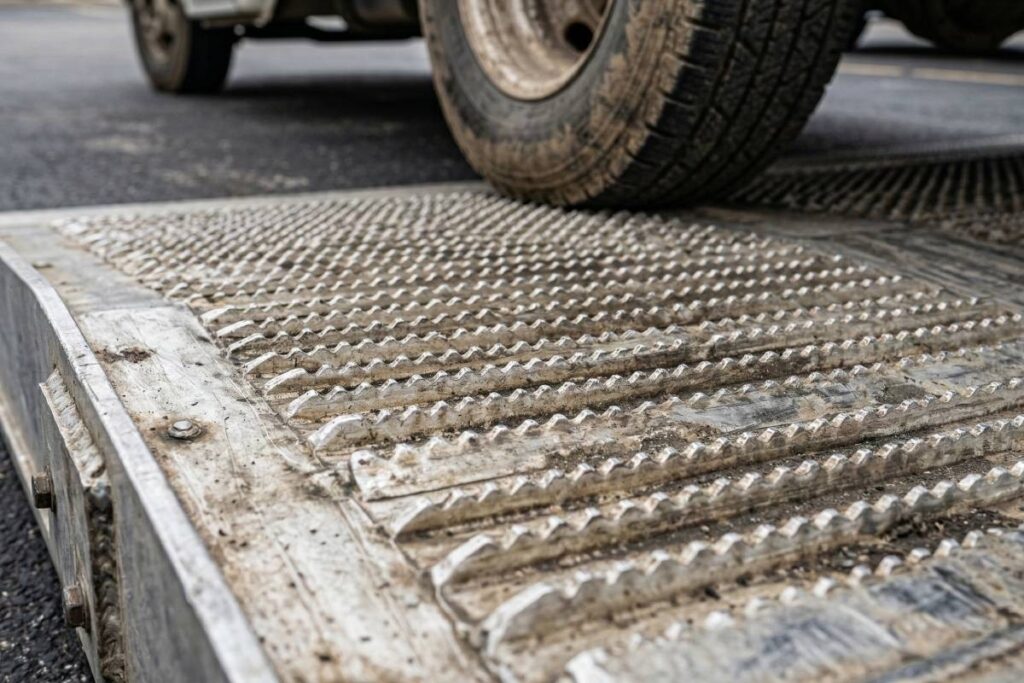
- Non-slip grip surfaces (serrated aluminium or rubber coating)
- Side rails or raised edges that prevent tyres from slipping off
- Weight capacity ratings are clearly labelled and appropriate for your cargo
- Locking mechanisms that secure the ramp to the truck bed or hitch receiver
Benefit 2: Protecting Your Equipment and Truck Bed
Your truck is an investment. So is everything you haul in it.
When cargo is dropped, dragged, or mishandled during loading, the damage compounds quickly. Truck beds get gouged. Tailgates get bent. Engines, blades, and hydraulic components on equipment get jolted and cracked.
A quality ramp creates a smooth, guided loading path that eliminates impact damage entirely.
Rubber feet on the ramp base protect your truck bed surface. Low-profile bi-fold ramps allow motorcycles and ATVs to roll on without any abrupt angle change that could ground out the undercarriage. For landscapers, this alone can prevent hundreds of dollars in equipment repairs each season.
Benefit 3: Saving Time on Every Single Load
Time is money. And on a busy job site or a packed weekend, every minute matters.
A single person with a proper ramp can load a piece of equipment in under two minutes. The same job without a ramp might require two or three people, improvised solutions, and multiple attempts.
Consider a landscaping crew that loads and unloads equipment six times per day across different client properties. Even a conservative estimate of five minutes saved per load adds up to 30 minutes of labour time recovered every single day. Over a 250-day work year, that is more than 125 hours of productive time returned to your business.
Multiply that by a crew rate of $25 per hour, and the math becomes impossible to ignore.
Benefit 4: Versatility Across Jobs, Vehicles, and Industries
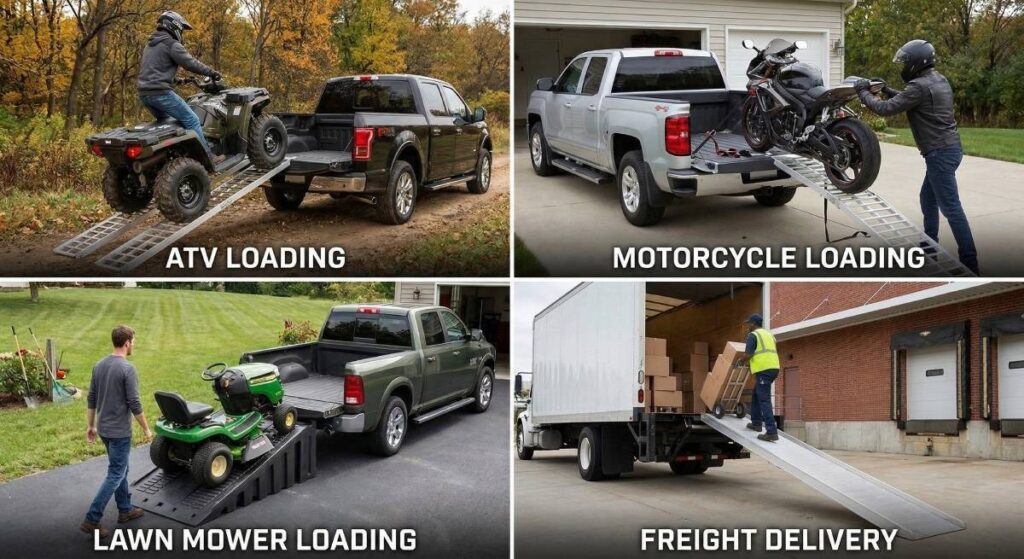
Truck ramps are not a one-trick tool. They serve an enormous range of industries and use cases.
Industries and users who benefit most:
| Industry | Common Use Case |
| Landscaping | Loading zero-turn mowers, tillers, edgers |
| Construction | Loading skid steers, compactors, generators |
| Farming / Agriculture | Loading ATVs, UTVs, small tractors |
| Powersports | Loading motorcycles, dirt bikes, snowmobiles |
| Moving / Relocation | Rolling heavy furniture and appliances |
| Automotive | Loading project cars, go-karts, race vehicles |
| Accessibility | Wheelchair and mobility device vehicle access |
| Retail / Delivery | Unloading freight from cargo vans and box trucks |
Modern ramp designs have evolved to accommodate this range. You can find folding ramps, arched ramps, channel ramps, and full-width loading ramps, each optimised for specific weight classes and cargo types.
Benefit 5: Long-Term Cost Savings That Add Up Fast
A premium aluminium truck ramp typically costs between $100 and $600, depending on length, width, and weight capacity. That sounds like an expense until you weigh it against the alternatives.
The hidden costs of NOT using a truck ramp include:
- Worker’s compensation claims averaging $41,000 per musculoskeletal injury (National Safety Council, 2023)
- Truck bed liner replacement ranging from $150 to $800
- Equipment repair costs from loading damage, often $200 to $2,000 per incident
- Liability insurance premium increases following preventable workplace injuries
- Lost productivity from injured workers or damaged equipment taken out of rotation
- Fire safety risks from improperly loaded fuel equipment, gas-powered machinery, or tipped cargo during transit
A single ramp purchase can offset its own cost within the first avoided incident. For businesses that load and unload daily, the return on investment is immediate and compounding.
Benefit 6: Accessibility and Independence
Not every truck ramp benefit is measured in dollars or minutes.
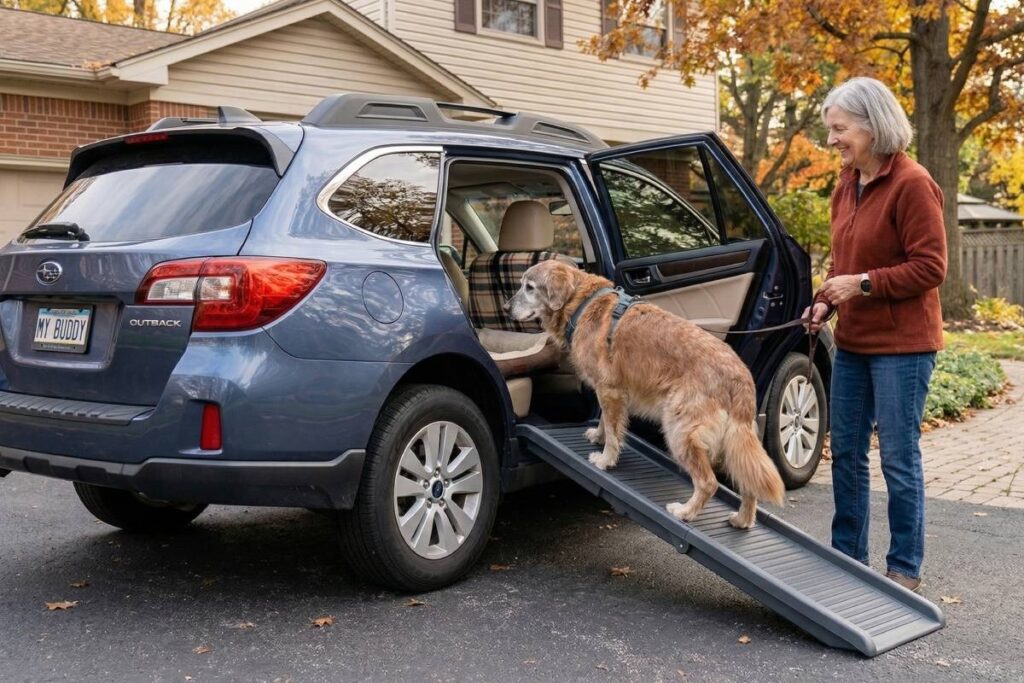
For individuals with mobility limitations, truck ramps provide genuine independence. Wheelchair-accessible ramps and pet loading ramps allow people and animals to safely enter and exit vehicles without the need for constant physical assistance.
This is a benefit that fundamentally changes daily quality of life for aging pet owners, individuals with physical disabilities, and caregivers managing patients who use vehicles for regular transportation.
Portable, lightweight aluminium ramps weigh as little as 12 to 18 pounds, making them easy to deploy and stow independently. For this audience, the benefit is not convenience. It is dignity and self-sufficiency.
Choosing the Right Ramp: A Side-by-Side Comparison
Not all ramps are created equal. Here is a breakdown of the most common types to help match the right ramp to your specific needs.
| Ramp Type | Best For | Weight Capacity | Key Feature | Example Brand |
| Bi-Fold Aluminum | ATVs, motorcycles | Up to 1,500 lbs | Compact fold, easy storage | SureWeld |
| Arched Aluminum | Lawn mowers, low clearance | Up to 1,200 lbs | High clearance at midpoint | |
| Channel Ramp (pair) | Motorcycles, wheeled equipment | Up to 2,000 lbs | Lightweight, tire-specific | |
| Full-Width Loading Ramp | Skid steers, large equipment | Up to 5,000 lbs | Maximum stability, wide platform | SureWeld |
| Folding Tri-Fold | Multi-purpose, trucks and vans | Up to 1,500 lbs | Adjustable, three-section fold | |
| Hitch-Mounted Ramp | Frequent users, fixed installation | Up to 1,000 lbs | Attaches directly to receiver hitch |
Pro tip: Always select a ramp rated for at least 1.5 times the weight of your heaviest load. This accounts for dynamic loading forces that occur when equipment accelerates or rolls at an angle during the loading process.
Brands like SureWeld have built their reputation on exactly this principle, engineering ramps with certified load ratings and heavy-duty construction that give users confidence their equipment is rated for real-world conditions, not just ideal ones.
Final Thoughts
Truck ramps are not a luxury accessory. They are a practical investment in safety, efficiency, equipment protection, and long-term cost control.
Whether you are a contractor loading heavy machinery every morning, a weekend warrior hauling your ATV to the trails, or someone simply trying to preserve the integrity of your truck bed, the right ramp transforms a risky and time-consuming task into a smooth, repeatable process.
The benefits stack up fast: fewer injuries, less damage, saved time, and real money kept in your pocket season after season.
Here is the question worth sitting with: If a single ramp purchase could prevent just one injury, one damaged piece of equipment, or one insurance claim this year, what is that actually worth to you?


